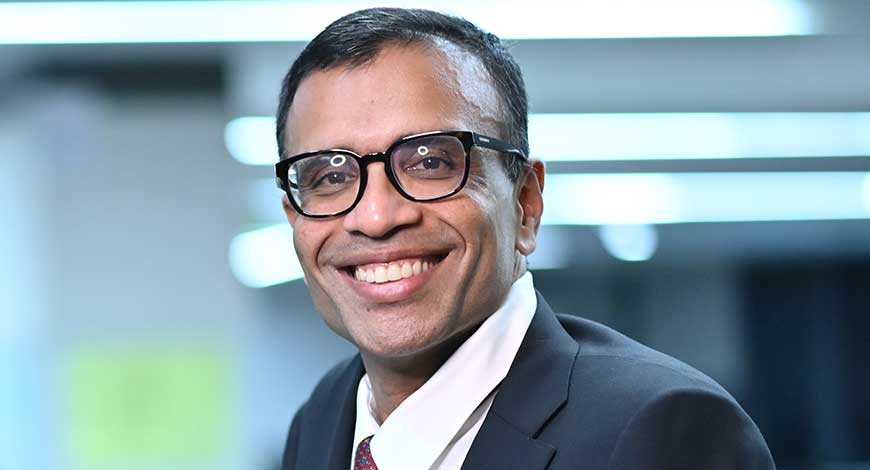
This exclusive interview features Matthew Thomas, Country Head – India, siemens digital industries software PLM. It shares insights from Realize LIVE on the evolution of PLM and its growing role.
The discussion also highlights AI, digital twins, and cloud technologies shaping modern manufacturing. Siemens helps manufacturers build intelligent, connected enterprises for the future.
Q1. At Realize LIVE, what is the core PLM message Siemens Digital Industries Software wants customers to take away about the next phase of product development, portfolio strategy, and connected enterprise innovation?
Answer:
The key message from Realize LIVE is that innovation is no longer about individual technologies—it is about bringing everything together into one connected ecosystem. During the keynote, five major themes emerged that define Siemens’ vision for the future:
- Software-defined vehicles
- Continuous verification and validation
- The next generation of Simcenter
- The Factory of the Future
- Intelligence-driven engineering and cloud technologies
Today’s products are increasingly complex.
Additionally, mechanical, electrical, electronics, and software engineering converge into a single development process.
siemens digital industries software PLM reflects this shift.
Customers are no longer looking for standalone solutions.
However, they want a connected enterprise.
Design, engineering, simulation, manufacturing, and operations must work seamlessly together.
Siemens’ portfolio is built around this philosophy, enabling siemens digital industries software PLM across every stage of the product lifecycle.
Q2. How is Siemens Digital Industries Software reimagining PLM beyond traditional lifecycle management to support more intelligent, connected, and cross-functional product development across design, manufacturing, and execution?
Answer:
PLM has evolved far beyond managing product data. Today, the entire product development lifecycle functions as a closed-loop system.
In the traditional workflow, companies would design a product, validate it for safety and performance, plan manufacturing processes, build it, and finally collect feedback after production. These were largely disconnected stages.
Now, all of these activities are integrated into one continuous process. Artificial intelligence is embedded across Siemens’ portfolio, helping customers make faster decisions, achieve smarter outcomes, and improve execution.
Ultimately, every customer is focused on three objectives:
- Improving product quality
- Accelerating new product introduction and time-to-market
- Delivering a better customer experience while reducing total cost of ownership
At the center of this ecosystem is Teamcenter, which serves as the digital backbone of Siemens’ PLM strategy, connecting every engineering, manufacturing, and operational function.
Q3. Where do you see the biggest strategic shift in the PLM portfolio today—industry-specific solutions, cloud-native delivery, AI-driven automation, or a combination of these—and how does that translate into customer value?
Answer:
It’s really a combination of all these elements working together.
Take the automotive industry as an example. Developing a completely new vehicle platform traditionally takes around 40 to 50 months. Today, manufacturers are asking how they can reduce that timeline by 40–50%.
Achieving this requires much more than improvements in one area. Companies need an integrated enterprise where design, simulation, manufacturing, and validation happen simultaneously rather than sequentially.
One major shift is “shift-left” engineering—moving simulation and validation earlier in the design process. Instead of designing first and discovering problems later, engineers can identify issues much earlier, reducing costly redesigns and minimizing physical prototypes.
This significantly shortens development cycles.
A good example is Sunlight Aviation. The company was incorporated only two years ago, yet it has already developed a working prototype. That level of speed is possible because of digital engineering and integrated development processes.
Ultimately, customers cannot afford five-year development cycles when markets evolve so quickly. Siemens’ strategy is focused on helping them innovate faster without sacrificing quality.
Q4. As product complexity continues to rise, how should companies balance long-term platform investments with short-term business execution while achieving greater speed without compromising engineering rigor?
Answer:
Every customer’s transformation journey is different.
We always encourage customers to begin with a clear long-term vision and then determine the best implementation approach based on their own priorities, available capital, existing talent, and business objectives.
Some organizations choose to implement a complete digital thread from the outset, while others prefer a phased roll-out. Both approaches are valid.
Cloud technologies also provide flexibility because customers can scale investments based on usage rather than making large upfront capital commitments.
Another important aspect is protecting existing investments. Many enterprise customers already have substantial infrastructure in place, and it isn’t practical to replace everything overnight.
Instead, Siemens focuses on working with existing systems, integrating new capabilities gradually, and enabling customers to scale at their own pace.
This is why openness, adaptability, and scalability are central to Siemens’ PLM strategy. Whether working with a startup or a large enterprise, the same platform can grow alongside the customer’s business without forcing disruptive technology changes.
Q5. Which industries are driving the strongest changes in PLM expectations, and what will be the clearest indicators that Siemens Digital Industries Software has successfully entered its next phase of PLM growth and transformation?
Answer:
Every industry is experiencing its own transformation, and each has unique challenges.
In automotive, Siemens works across the ecosystem—from passenger vehicle manufacturers to two-wheelers, electric vehicles, internal combustion engine platforms, and Tier 1, Tier 2, and Tier 3 suppliers.
Industrial machinery and heavy equipment continue to see strong demand, particularly as infrastructure development accelerates with new roads, airports, and large-scale construction projects.
The aerospace, defense, and naval sectors are also growing rapidly, driven by increased participation from private manufacturers and emerging startups.
Mobility startups are solving multiple challenges simultaneously, including sustainable transportation, electrification, and new mobility models.
Enterprise manufacturers are also focused on maximizing the value of existing assets and improving operational efficiency through digitization.
Beyond discrete manufacturing, Siemens is seeing increasing demand from process industries such as consumer packaged goods and tire manufacturing.
The semiconductor sector is another major growth area, supported by initiatives such as India’s Semiconductor Mission (ISM 2.0), production-linked incentives (PLI), and design-linked incentive programs.
Across every sector, organizations are pushing the boundaries of innovation, speed, sustainability, and efficiency. The next phase of PLM growth will be measured by how successfully companies can connect these capabilities into a unified digital enterprise that accelerates innovation while improving quality and competitiveness.